
Learn · Research notes
When dual momentum loses to equal-weight
On US-only and world-equity-only menus, dual momentum lost to that menu’s own equal-weight. Themes and charts from our multi-asset stress tests.
Direct answer
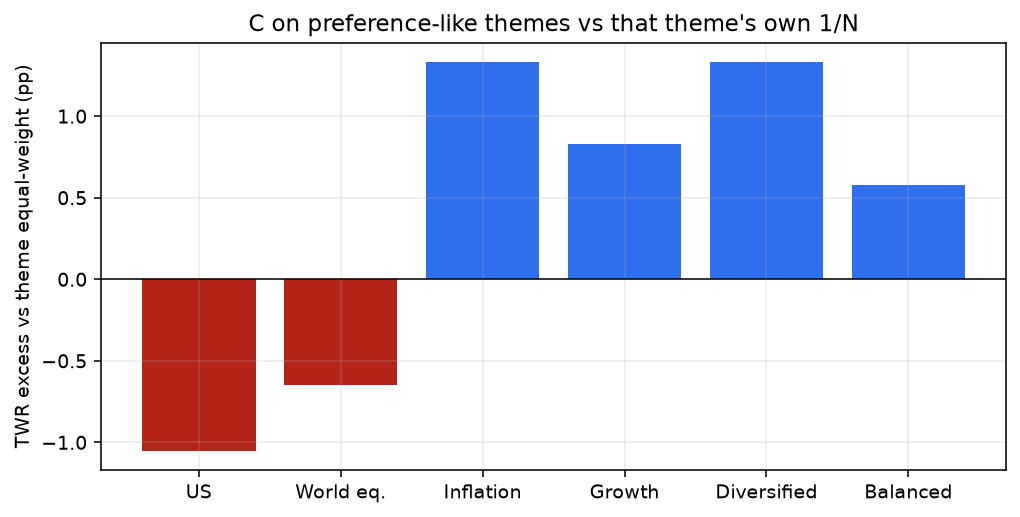
Dual momentum is not a drop-in for any checkbox list. Equity-only preference themes underperformed their own 1/N. A cross-asset field is where the historical edge appeared.
The product fantasy
“Pick any markets you like; we place the paycheck.” That sentence needs the rule to work on arbitrary subsets. Our stress tests say it does not.
What failed
| User-like field | vs own equal-weight (TWR) | |---|---| | US (SPY, QQQ, IEF, GLD) | negative | | World equities (SPY, VGK, EWJ, EEM) | negative | | Inflation / diversified mixes with gold & bonds | positive in sample | | Growth (SPY, QQQ, EEM) | positive in sample, but fragile |
If the only markets you want are US names — or only world equities — equal-weight (or simple SPY DCA) is the honest default. Running dual momentum anyway would be cargo-culting a rule outside the sample where it helped.
Practical takeaway for calculators
Most people searching “S&P 500 DCA calculator” should run one market, fixed contribution. See the S&P 500 DCA calculator. Multi-asset ranking is a research note, not the default tool.
Frequently asked questions
- When dual momentum loses to equal-weight?
- Dual momentum is not a drop-in for any checkbox list. Equity-only preference themes underperformed their own 1/N. A cross-asset field is where the historical edge appeared.
- Do you sell a trading strategy based on this research?
- No. These pages document what we tested and why we do not sell a paid allocator. Use the free S&P 500 DCA calculators instead.
Run the numbers on real history
Guides are cheap. Seeing a monthly habit on published S&P 500 prices is the point.