
Learn · Research notes
What our investing research actually found
A plain summary of years of tactical and DCA experiments — timing, sectors, dual momentum — and why SteadyGrow is free calculators, not a paid strategy.
Direct answer
We tested DCA timing, sector rotation, and dual momentum on real prices. None cleared a bar high enough to sell as a paid allocator. The honest product is historical S&P 500 DCA and related calculators.
What was the question?
SteadyGrow started as an attempt to answer: *can a simple, systematic rule improve a monthly investing habit without becoming a stock picker?*
We locked month-end prices, lag-1 signals (no same-bar cheating), fixed contributions, and costs. We scored books on time-weighted return (TWR), drawdowns, and rolling windows — not on a naive “final wealth / first deposit” CAGR that flatters contribution paths.
What survived long enough to write about?
Three big forks:
- DCA timing — skip or boost the same paycheck based on signals. Marketing-looking wins were usually invent-cash or path effects. Honest pot timing ≈ blind DCA.
- Sector / country rotation — try to beat the S&P 500 with sleeves of the same equity market. Full-sample tricks died in walk-forward and cost stress.
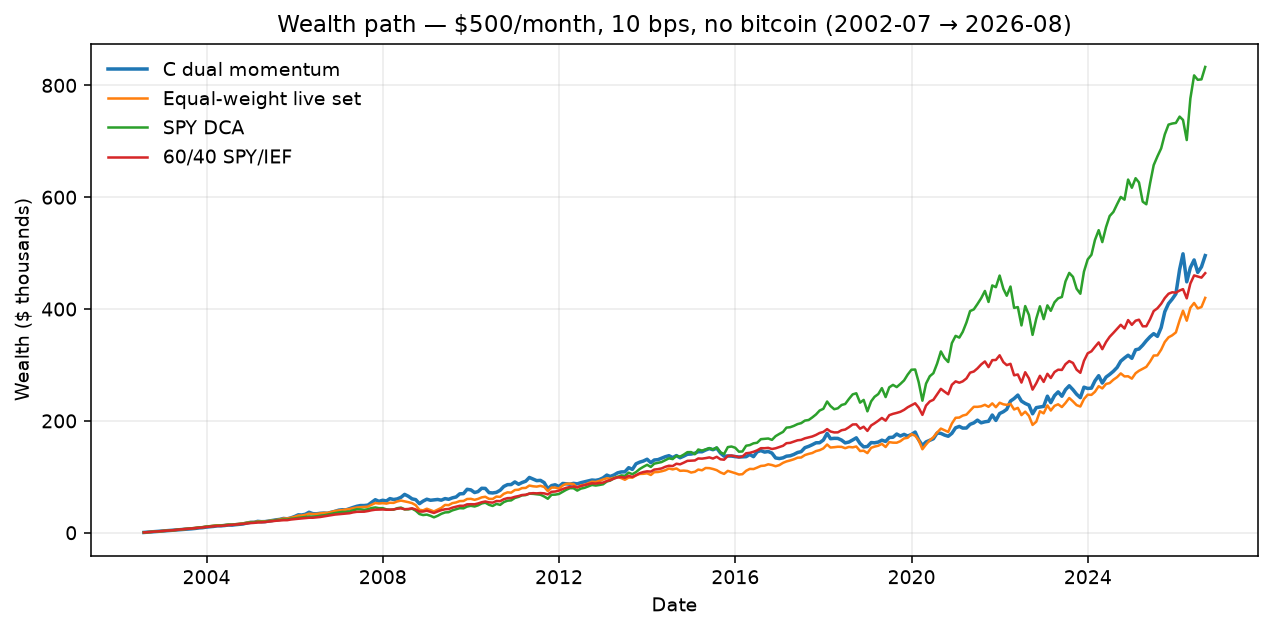
- Multi-asset dual momentum — among diversified asset classes, send new money to names still in an uptrend. Beat equal-weight of that same menu by roughly +1.2 percentage points of TWR in 2002–2026 — interesting research, not a product you sell as “several percent a year.”
What should you do with this?
Use SteadyGrow for what the evidence supports:
- Run an S&P 500 DCA calculator on real history.
- Compare lump sum vs DCA.
- Read what-if scenarios instead of chasing a “smart” monthly sleeve.
We keep publishing the research so we (and you) do not pretend a weak edge is a product.
Frequently asked questions
- What our investing research actually found?
- We tested DCA timing, sector rotation, and dual momentum on real prices. None cleared a bar high enough to sell as a paid allocator. The honest product is historical S&P 500 DCA and related calculators.
- What was the question?
- We tested DCA timing, sector rotation, and dual momentum on real prices. None cleared a bar high enough to sell as a paid allocator. The honest product is historical S&P 500 DCA and related calculators. See the full guide and linked calculators on this page for the historical numbers.
- What survived long enough to write about?
- We tested DCA timing, sector rotation, and dual momentum on real prices. None cleared a bar high enough to sell as a paid allocator. The honest product is historical S&P 500 DCA and related calculators. See the full guide and linked calculators on this page for the historical numbers.
- What should you do with this?
- We tested DCA timing, sector rotation, and dual momentum on real prices. None cleared a bar high enough to sell as a paid allocator. The honest product is historical S&P 500 DCA and related calculators. See the full guide and linked calculators on this page for the historical numbers.
- Do you sell a trading strategy based on this research?
- No. These pages document what we tested and why we do not sell a paid allocator. Use the free S&P 500 DCA calculators instead.
Run the numbers on real history
Guides are cheap. Seeing a monthly habit on published S&P 500 prices is the point.